

4 minute read
Small businesses mean big returns for issuers
Banks and business owners stand to gain by converting small business owners using personal credit cards to commercial cards.
Small businesses account for nearly 90% of all organizations globally, and that number is even larger in the United States. With so much of the economy powered by small businesses, issuers have a vast untapped revenue opportunity before them. Many small businesses still use personal credit cards rather than commercial cards, and both issuers and cardholders are missing out.
Small businesses have similar needs as other companies. However, they can be more vulnerable to swings in demand for their products and services than larger companies due to their size. Operational efficiency is paramount to keep costs reasonable, plan for growth and preserve working capital. Commercial cards help meet these critical needs by providing tools for expense management, employee monitoring of spending and cash flow management.
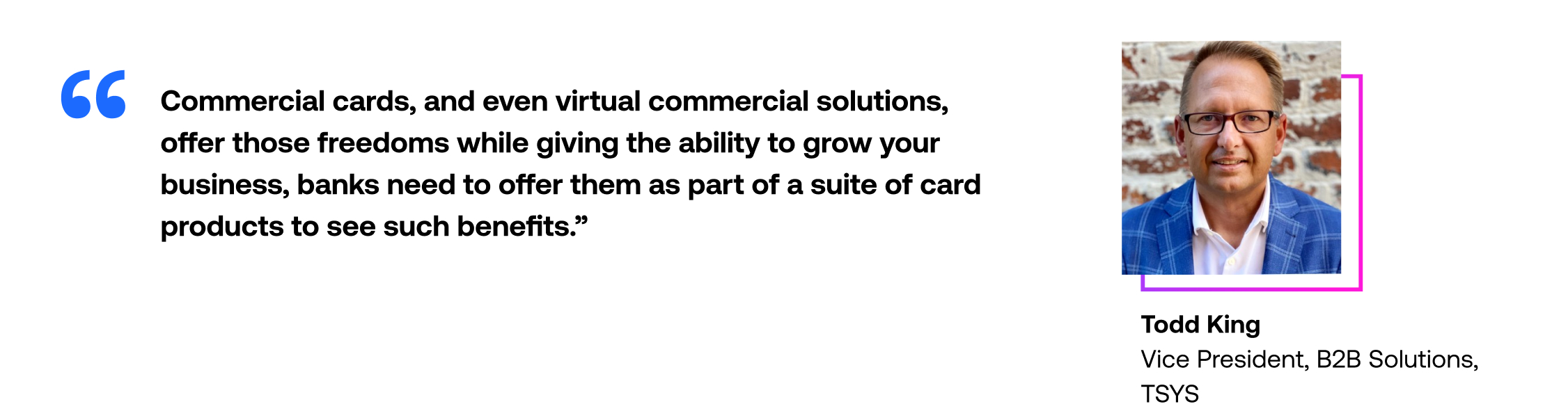
Issuers revenue opportunity
The number of small businesses in the United States rose to 33.2 million in 2021, according to the latest census conducted by the Small Business Administration in a 2022 report. And commercial cards make up a little more than a third of total business-to-business spending in the United States, according to research by Mercator Advisory Group.
From the perspective of issuers—shifting small businesses to commercial cards from personal cards has the potential to improve their bottom line. Commercial cards bring higher interchange revenue, and tend to have higher transaction volumes. A data analysis, conducted by TSYS, for a mid-size financial institution in January, found that average interchange fees were 1.88% for consumer cards and 2.49% for commercial cards. So for each cardholder the issuer can migrate to a commercial card, it stands to make higher interchange. Hypothetically, if the financial institution were to convert its small business cardholders who use personal cards to commercial cards, they could potentially generate another $1.5 million per year in interchange and transaction revenues. The issuer estimated it could boost the number of accounts in its commercial card portfolio by 10% by converting business owners with personal cards.
Meeting the needs of business
Compelling as that is, moving small business customers to commercial cards is also beneficial for other reasons. Commercial cards are much more suited to business use for a number of reasons. They offer higher credit limits than personal cards, allow the cardholder to establish a separate credit history and give the flexibility of having employee cards. Commercial cards are also part of a suite of solutions that issuers and businesses need to support treasury management, including managing disbursements, working capital and overall risk.
Another critical feature of commercial cards is how they are going mobile. Issuance of digital payment cards, or virtual cards, will reach 1.3 billion by 2027, up from 500 million this year, according to a 2023 report by Juniper Research. Virtual commercial cards have much more flexibility for the small business, where the main accountholder can issue them instantly to employees or contractors, with spending limits, time limits and restricted merchant categories, all helping companies minimize fraud.
Yet issuers need to articulate the power of commercial cards to their small business customers using personal credit cards. They should explain the need of their appeal, of how they offer benefits such as keeping personal and work finances separate, building company credit and driving better accounting and reconciliation practices. While these are all basic services small businesses need, banks and credit unions are passing up a chance to deepen their relationships by not migrating customers to commercial cards.
Robust reporting drives commercial growth
Cardholders generate enormous quantities of data. If issuers use this data effectively—such as by filtering by account type and size—they gain analytical insights on cardholder activity in their small business segment. That robust reporting allows issuers to make strategic moves based on individual accounts and segments as a whole. Plus, these actionable insights open potential revenue growth opportunities in their commercial portfolio.
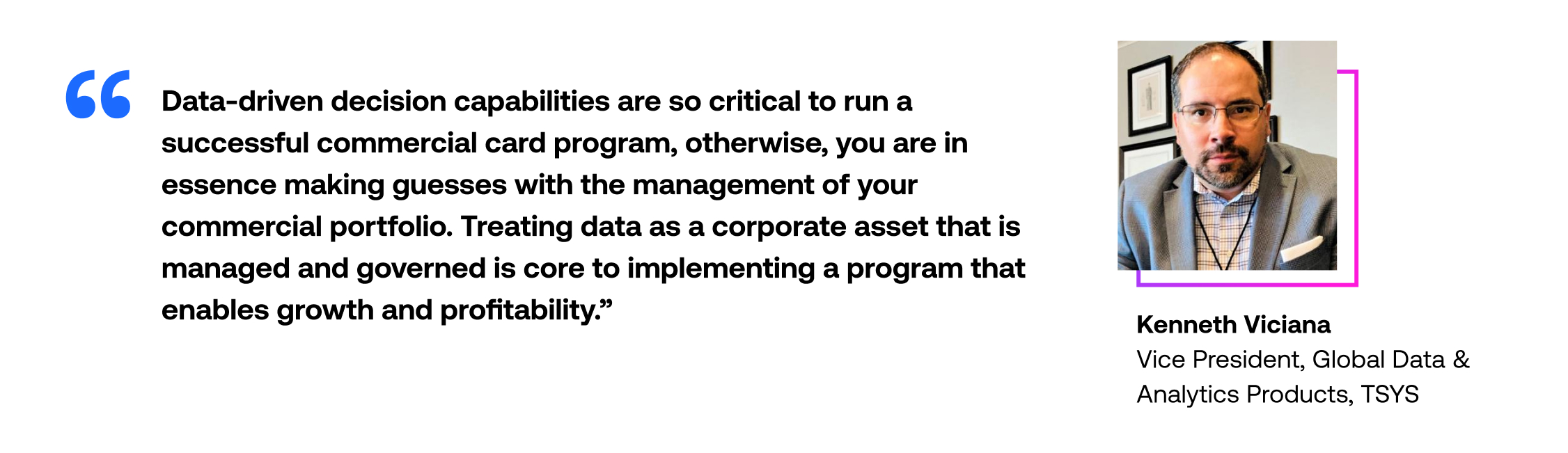
Enabling these data insights allows issuers to see how each account, based on company type and size, is performing individually and as a segment. These insights provide behavioral insights that are crucial to make better business decisions. This means issuers can pivot their commercial activity based on small business cardholders to improve the customer experience and boost profitability.
Find out more
Issuers are faced with the opportunity for rapid commercial growth. In the steadily expanding market, converting personal small business cardholders to commercial accounts increases potential revenues and customer retention. Small businesses will benefit from this conversion in driving efficiencies and growing their operations.
If you are interested in learning more about how to grow your commercial card portfolio as well as TSYS’ commercial card offerings, VPP, and TSYS analytics solutions, click here.
Latest articles


Never Miss an Insight
Get the latest from TSYS a Global Payments Company